Air Peace volunteers to Evacuate Nigerians from South Africa FOC


The Ministry of Foreign Affairs wishes to inform the general public that following the recent unfortunate xenophobic attacks on foreign nationals, including Nigerians in South Africa, the Proprietor of Air Peace Airlines Chief Allen Onyema, has volunteered to send an aircraft from Friday 6th September 2019 to evacuate Nigerians who wish to return to Nigeria free of charge
The general public is hereby advised to inform their relatives in South Africa to take advantage of this laudable gesture
This was contained in a statement made available to newsmen signed by the Ministry spokesperson Mr Ferdinand Nwonye.
According to the statement, “Interested Nigerians are therefore advised to liaise with the High Commission of Nigeria in Pretoria and the Consulate General of Nigeria in Johannesburg for further necessary arrangement.”
Curled from vanguard


Sport
17-Year-Old French-Ivorian Moïse Kouamé Makes History at Roland-Garros 2026 and France Has Found Its Next Tennis Star


There are debuts, and then there are arrivals. What Moïse Kouamé has done at Roland-Garros 2026 belongs firmly in the second category. The 17-year-old French-Ivorian tennis prodigy has turned the Paris clay into his personal stage, becoming the youngest male player to reach the third round of a major since Rafael Nadal in 2003, a milestone that, given what Nadal went on to do with the rest of his career, carries a weight that the Paris crowd has been quick to feel and even quicker to celebrate.
The day after Roland-Garros waved goodbye to one of its favourite sons in Gaël Monfils, Kouamé gave French tennis a fresh reason to get excited with a stunning debut win at the clay-court major, overcoming former World No. 3 and 2022 Roland-Garros semi-finalist Marin Cilic 7-6(4), 6-2, 6-1 on Court Simonne-Mathieu to announce himself to the Paris fans in style. The timing of Monfils’ farewell and Kouamé’s emergence felt almost scripted, a passing of the torch so perfectly timed that French tennis fans could be forgiven for thinking someone had arranged it.
Kouamé then continued to elevate his status as France’s newest tennis sensation, surging into the third round with a milestone not achieved by a player his age since Nadal at Wimbledon in 2003, defeating Adolfo Daniel Vallejo 6-3, 7-5, 3-6, 2-6, 7-6(8) amid a vibrant atmosphere on Court Suzanne-Lenglen in a match lasting four hours and 56 minutes. It was the kind of match that forges reputations, the kind where a teenager is given every opportunity to collapse and instead chooses, repeatedly and defiantly, to stand.
The match, the longest of the tournament, saw Kouamé lead two sets to none, get pegged back, lead 5-2 in the fifth, get pegged back again, and eventually settle the matter with a decisive serve-and-volley in a super tie-break he had led 6-1 before Vallejo clawed back, a finish that brought the entire Suzanne-Lenglen crowd to its feet. For a 17-year-old playing his first Grand Slam main draw, the composure on display was not merely impressive. It was jaw-dropping.
His run ultimately ended in the third round, where Alejandro Tabilo defeated him in a 3-hour-40-minute battle across four sets, 4-6, 6-3, 6-4, 7-6(9), but even in defeat, Kouamé left the Porte d’Auteuil crowd with the clear impression of a young man who had marked his territory at one of sport’s most prestigious venues, at just 17 years old.
Having started 2026 as the world number 876, Kouamé has now ensured he will break the top 300 after Roland-Garros. And if his demeanour throughout the tournament is anything to go by, the ranking climb is the least interesting thing about him. “Winning Roland-Garros is, of course, a dream,” Kouamé said with a smile. “Being World No. 1 is also a dream.” At 17, on the back of a debut Roland-Garros run that has already rewritten record books, those words do not sound like the wishful thinking of a teenager. They sound like a schedule.

The Nigeria Union of Teachers (NUT), Oyo State Wing, has directed all public primary and secondary school teachers in the state to embark on an indefinite strike beginning Monday, June 1, 2026, over the continued captivity of abducted teachers and pupils in Oriire Local Government Area.
The directive follows growing concerns about the safety and security of teachers and students after 46 pupils and their teachers were reportedly abducted by suspected terrorists in the Ahoro-Esinele and Yawota communities.
In a statement jointly signed by the Chairman of the Oyo State NUT, Hassan Fatai, and the Secretary, Salami Olukayode, the union said the prolonged detention of the victims has generated fear and anxiety among teachers, discouraged school attendance, and heightened tension within affected communities.
According to the union, the strike action is aimed at drawing the attention of government authorities and security agencies to the urgent need to intensify efforts toward the safe and unconditional release of the abducted teachers and pupils.
The NUT directed all teachers in public primary and secondary schools across Oyo State to fully comply with the industrial action and remain at home pending further directives from the union.


There is a phrase being deployed with increasing urgency in the build-up to the Ekiti State governorship election, and it is carrying more weight than political sloganeering typically warrants. “Ballot revolution.” It is the language of Oluyede and in the mouth of a man who has clearly thought carefully about what ails governance in Ekiti and what, precisely, it would take to fix it, the phrase is not hyperbole. It is a diagnosis and a prescription delivered in the same breath, aimed squarely at a citizenry that Oluyede appears to believe is ready to be spoken to seriously rather than managed quietly.
Oluyede’s central argument is as straightforward as it is demanding that the quality of governance a people receive is inseparable from the quality of choices they make at the ballot box. It is a position that sounds obvious until you sit with the full implications of what it requires, not just the act of voting, but voting with intention, with information, with resistance to the inducements and intimidations that have historically shaped electoral outcomes in Ekiti and across Nigeria more broadly. A ballot revolution, in this framing, is not about violence or rupture. It is about consciousness, a collective awakening to the idea that the power to determine who governs, and therefore how life is lived in Ekiti, resides not in Abuja or in the offices of political godfathers but in the hands of ordinary Ekiti people standing in a queue on election day.
The timing of this message matters. Ekiti State has a political history that is simultaneously rich with civic energy and scarred by the kind of electoral manipulation that has repeatedly produced a gap between what voters intended and what governance ultimately delivered. The state has punched above its weight in producing educated, articulate, and politically engaged citizens, and yet the translation of that civic energy into consistently accountable governance has remained an unfinished project. Oluyede’s invocation of a ballot revolution speaks directly to that frustration, naming it without euphemism and challenging the electorate to respond to it differently this time.
Good governance, as Oluyede frames it, is not a gift that falls from the sky or filters down from the goodwill of powerful men. It is extracted, demanded, insisted upon, voted into existence by people who refuse to accept the alternative. In Ekiti, where the 2026 governorship race is shaping up as one of the more consequential electoral contests in the South-West, that extraction will require exactly the kind of collective civic discipline that the ballot revolution concept demands. Candidates will make promises. Party structures will deploy resources. And voters will, as they always do, face the moment of truth in the polling booth where everything that has been said publicly must be weighed against everything that has been felt personally.
What Oluyede is betting on, and what his ballot revolution message implicitly trusts, is that Ekiti voters are capable of making that moment count. It is a bet on the electorate’s intelligence, dignity, and appetite for change that many in Nigerian politics are reluctant to make. Whether the people of Ekiti vindicate that bet when it matters most will be the real story of this election, and it is a story that no political strategist, no party machine, and no amount of campaign spending can fully script in advance.

 News2 years ago
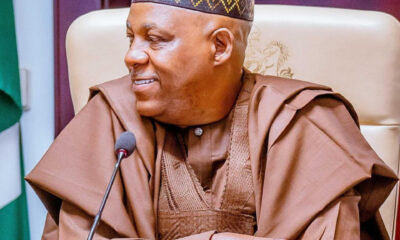
Hardship: We Plan To Establish A National Commodity Board To Crash Food Prices – VP Shettima
- News8 years ago
Blog Reader; Samson Osagiede Celebrates Fiancè Benedicta Daniels’s Birthday With Sweet Words
- Home10 years ago
News Channel claims Donald Trump is an orphan from Pakistan,share alleged childhood photo
- Home10 years ago
Another $175m Found in Patience Jonathan’s wife’s firm’s Bank Account
- Home10 years ago
Oil Spillage: House of Reps Member Shares Photos of the Water her Constituents Drink .
- Home9 years ago
Zara Buhari & Ahmed Indimi’s Wedding Access Card
 Sport8 years ago
Modric, Marta Wins 2018 FIFA Best Player Of The Year Awards ⚽️
- News8 years ago
The Best Video You’ve Seen Today?