News
The Brexit Nightmare ByReuben Abati

What has the United Kingdom just done to itself, its people and the future of its self? It is difficult to fully understand why a country in taking a decision about its future will decide on a false option that seems to negate long-term interests.
And this, just because a total of 17.4 million people out of over 61 million chose to vote against the United Kingdom’s continued membership of the EU. More than 50% of these pro-Brexit voters are actually between the age bracket: 50-70, thus an ageing class of voters has taken a decision to undermine the future of the younger generation.
Pro-EU Prime Minister David Cameron said he was “courageous and optimistic ” when in January 2014, he tried to justify the need for a referendum.
His words then: “ I think the overwhelming majority of the British people say they want to be in Europe but they want some changes to the relationship and they would like to be given a say. It is not something that we should be frightened of. It’s something we should embrace.” Cameron is now a study in political miscalculation and how over- confidence can make a political leader misread the people’s moods and expectations. He has been praised for his “courage” in quickly accepting the people’s verdict and for tendering his resignation, but I guess he won’t possibly be talking about courage. He must be full of regrets for presiding over the United Kingdom’s exit into a nightmare. Britain is better off remaining in the EU. But on June 23, 2016, the people of Great Britain spoke and their verdict has been accepted as the status quo, except a miracle happens and the current petition by the pro-EU protesters results in a second referendum. As things stand, the people have rejected continued membership of the European Union. The implication is that the majority of the people believe that the United Kingdom is better off on its own. What is quite clear is that this British exit (Brexit) is more about the rise of xenophobia, bigotry and isolationism. It is not new. Britain has always looked backward and in-out in the course of its membership of the EU, oscillating between its commitment to a greater Europe and the need to preserve British identity and sovereignty.
The British public mind has been driven in recent years by loud, perpetual carping about too much control from Brussels, and the
need to project Britain first. The ultra nationalists nursed fears about their great country becoming a colony within a EU empire. They are uncomfortable with the apparent globalization of British demographics, turning Britain into a country of many racial colours, with the influx of so many immigrants who are empowered by EU laws to be free citizens of a united Europe. The call for a referendum on this matter has now given the Brexiteers, who jus want their country to be left alone by outsiders, the opportunity they have always wanted. PM Cameron apparently underestimated their resolve. The Leave EU activists campaigned more vigorously, and deployed every possible means including blackmail and sentiments. They had the vibrant support of many political leaders including former London Mayor Borns Johnson, Michael Gove, and fire-eating UKIP leader, Nigel Farage. In the event of an intense campaign that divided the country right down the middle, we witnessed the mainstreaming of xenophobia and bigotry. Labour MP Jo Cox who was murdered by an irate Eurosceptic for her pro-EU stance will be remembered as the symbol of how a straightforward, for or against, political debate turned into hate campaign and a national referendum became an act of terror. There are many lessons to be learnt from this instructively low moment in Britain. What has happened is actually a referendum on the British establishment and the EU. The EU faces a crisis requiring urgent introspection and reform of its processes, if it must continue to serve its purpose. Britain is not the first country to avoid membership of the EU but whereas countries like Switzerland and Norway can hold out on their own, Brexit comes at great cost to the British. At hand is the triumph of emotions over reason, and the triumph of right wing populism. In many countries of Europe and even at the moment in the United States, the ultra-conservative political bloc seems to be in the ascendancy. Questions are being asked about regional integration and globalization. The basis for this is largely the manner in which regional groupings such as the EU disappoint the people. This is made worse by the failure of the leadership elite and sitting governments. When people are not happy with their governments or their circumstances,
they are ready to make any choice that looks like an alternative. Opposition and anti-establishment politicians understand this game too well.
All they need to do is to demonize the establishment, tear the government of the day into pieces, call names and tell the people that the time has come for change. Those who claim that they best know how to save a nation, armed with populist rhetoric in an election time, and have the best support of the people, in the long run stand a better chance of winning. Democracy in that fashion is a play-field of emotions, not facts. It is the same scenario that made Bernie Sanders so popular in the recent Presidential nomination process in the United States, and also led to the emergence of Donald Trump as the presumptive Republican Presidential candidate. Political leaders who don’t want sad outcomes only have to provide good leadership and meet the people’s
expectations. It is also clear that democracy may not produce rational outcomes in so far as it awards triumph on the basis of percentages: in Brexit, the difference is just 4%, 58-42, but the rule of the game is that majority carries the day, and as in most cases, the winner takes it all. But should the economic and political destiny of a people be determined in such formulaic manner?
Brexit has left the United Kingdom in a more divided shape that it was before the referendum. The entire country is in turmoil.
The taste of change doesn’t quite seem so sweet anymore, less than 72 hours after the vote. Young Britons may no longer be able to
move freely across Europe and the experts have predicted rising costs and expectations and greater economic hardship. If Brexit
stands, more than half of the population will be thrown into a winter of discontent, wondering why just about 1.3 million voters
(17.4 million (for), 16.1million (against) should have been allowed to mislead a country. Many Britons will no longer be able to find jobs so easily across Europe. Hyperdemocracy has resulted in British discombobulation. But that is democracy: it includes the people’s right to make mistakes, that is – the right of the simple majority to make mistakes at the expense of the minority, who may have lost the vote due to poor turn out or other matters of logistics. Leadership counts. The truth is that the leadership elite in Britain has also not always being too clear about where Britain should stand in relation to the rest of Europe. Even the pro-EU political leaders do not really object to Britain holding on to its national currency, the Pound, as opposed to the Euro, and Britain opting out of the idea of being a Schengen border. Britain also did not join the European Economic Community until 1973, 16 years late. Two years later, there was an exit referendum similar to this one, won by the pro-Europe campaigners. Nothing forecloses the possibility of another referendum in the not too distant future to reverse the present decision. What has happened isperhaps all correctly British, in the final analysis: a nation yet to come to terms with certain odern realities, caught between nostalgia and the future. This is precisely what the copycat plebiscites should understand, particularly in Africa where some commentators have been saying that some African countries on account of Brexit may begin to raise question about the relevance of the African Union. The AU is modeled after the EU and it receives substantial funding support from it, but it has not been as remotely relevant in addressing the people’s expectations. In my opinion, there is nothing to fear in terms of a copycat effect in Africa; most Africans are
indifferent about the AU anyway, they are not even aware of its existence. But as most development aid received by African countries come from the EU, this may be negatively affected with the exit of a major country like Britain, and a post- EU Britain may also be compelled to adjust its trade relations, immigration rules, and development support for countries in Africa. This, I think, is all there is to it at this end. Closer home, the more strident call is for a referendum on the Nigerian union. In the last few days, I have for example, seen a strange Nigerian invention called “Biafrexit”. This must be a joke, symbolically thrown up by those who must know that no Nigerian government will allow such a vote. The Brexit vote was not about disintegration, even if Scotland is now insisting on its independent right to be part of the EU; rather the vote was more about national and economic identity. Nigeria is
still at the level of debates: we can hold as many conferences as we like, adjust the Constitution at mutually agreed terms, but a
referendum that could lead to the dissolution of this country is not what we need, and it is certainly not the lesson from Brexit.


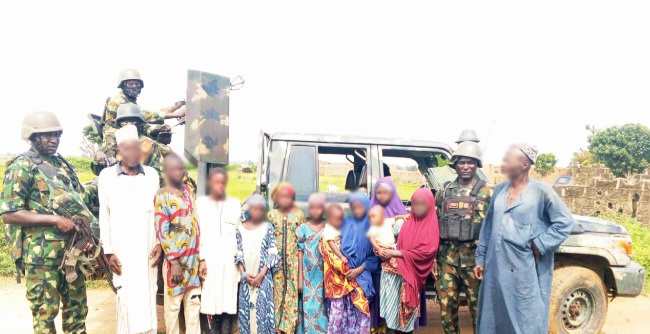
Troops of the Joint Task Force North West, Operation FANSAN YAMMA, have rescued 31 kidnapped victims during separate operations in Katsina and Kebbi states.
The operations, conducted on September 14 and 15, also led to the death of two suspected terrorists, the arrest of two others and the recovery of ammunition, a motorcycle, camouflage clothing and other items, according to the task force.
10 Kidnap Victims Rescued in Katsina
In Katsina State, troops of Sector 2 rescued 10 kidnap victims following reports of abductions in Unguwan Daudu and Unguwan Chibauna communities in Funtua Local Government Area.
The victims comprised three males and seven females, including an infant.
According to the military, troops launched a hot pursuit after receiving the reports and engaged the suspected terrorists in a gun battle, leading to the successful rescue of the victims.
The rescued persons were subsequently taken into military custody for further action.
21 Victims Rescued in Kebbi
In Kebbi State, troops responded to a distress call following the abduction of civilians from Fafala Village in Kangiwa Local Government Area.
Acting on what the military described as credible intelligence, the troops conducted a fighting patrol towards Fafala and Dandikwa, where they engaged the suspected terrorists in a heavy exchange of fire.
The gun battle reportedly forced the attackers to withdraw, allowing the troops to rescue 21 victims.
The rescued victims were later reunited with their families.
Two Terrorists Killed in Katsina
The military also reported a separate operation in Katsina on September 15, during which troops foiled an alleged plan to attack communities in Matazu and Kankara local government areas.
The troops reportedly moved towards a suspected terrorist hideout and engaged the group with superior firepower.
Two suspected terrorists were killed, including Abbah Alhassan, whom the military identified as a known terrorist kingpin. Other suspected terrorists reportedly fled into the surrounding bush.
Items recovered from the area included 10 rounds of ammunition, a motorcycle, a cutlass, camouflage clothing and Indian hemp, among other items.
Two Suspected Terrorists Arrested
In another operation in Katsina, troops arrested two suspected terrorists around the Yantumaki general area of Dan Musa Local Government Area.
Preliminary interrogation, according to the military, indicated that the suspects were allegedly associated with a suspected terrorist kingpin identified as Mannori.
The two suspects remain in custody for further investigation.
Military Urges Public Vigilance
The Joint Task Force said the operations demonstrate its continued efforts to rescue kidnapped victims, disrupt terrorist networks and restrict the activities of armed groups across its area of operation.
The task force also thanked members of the public for their support and urged residents to remain vigilant and promptly report suspicious activities to security agencies.

The Nigeria Customs Service (NCS) and the Republic of Benin Customs have launched a technology-driven system aimed at making cross-border trade between both countries faster, more transparent and easier for traders.
The initiative, known as the Customs Declaration Exchange System (CDES), is designed to connect the operations of the two customs administrations while improving coordinated enforcement and harmonising border procedures.
New Digital System Targets Border Delays
The Comptroller-General of Customs, Adewale Adeniyi, announced the initiative during the Joint Nigeria-Benin Customs meeting on the assessment of the One Stop Border Post at the Seme-Krake border in Lagos State.
The meeting was themed “Leveraging the Nigeria Customs Service Trade Modernisation Project to Advance Seamless Cross-Border Trade and Shared Responsibility.”
Adeniyi said the system is expected to improve interconnectivity between the two customs administrations and establish a framework for more accountable joint governance.
Focus on Women Traders
The Customs chief said the digital system would particularly benefit women who participate in informal cross-border trade.
According to Adeniyi, women account for more than 70 per cent of informal cross-border traders along the corridor. He said many women traders face challenges including harassment, extortion and delays while moving goods across the border.
The CDES is therefore expected to simplify procedures for small consignments and make information about customs requirements available in languages traders can understand.
A dedicated complaint channel is also expected to provide women traders with a way to report cases of poor treatment at the border.
System Could Reduce Repeated Customs Checks
Adeniyi said one of the major measures of the system’s success would be whether traders and transporters could avoid unnecessary duplication of customs procedures.
He gave the example of a truck carrying goods from Cotonou to Lagos, saying the objective was for it to clear the border once rather than undergo repeated processes on both sides.
He also said the system should eventually allow traders to cross the border within an hour rather than spending an entire day dealing with border procedures.
Nigeria, Benin Customs Plan System Interconnectivity
The technical team working on the project has presented processes for deploying the CDES across both countries.
The two administrations are also considering co-locating their customs administrations and systems at the border, which would allow officers on either side to access relevant information and coordinate decisions more effectively.
Adeniyi said connectivity between the systems would be critical to the success of the project.
He added that within about three months, the systems should begin working once the necessary technical connections and administrative cooperation are established.
Benin Customs Expresses Readiness
The Director-General of Customs in Benin Republic, Colonel Raouf Aboudou, expressed confidence in the initiative and pledged his administration’s cooperation.
Aboudou said the system was developed jointly by the two customs administrations and expressed optimism that it would improve trade between Nigeria and Benin.
He stressed that the success of the project would depend on joint commitment rather than policy declarations alone.
Potential Boost for Regional Trade
The initiative could also serve as a model for digital customs cooperation beyond the Nigeria-Benin corridor.
Adeniyi said that once the two countries achieve full interoperability, they would have created a possible template for online border crossings across ECOWAS and the wider African continent.
The move also aligns with broader efforts by West African customs administrations to harmonise procedures, strengthen digital interoperability and improve coordinated risk management.
For traders and transporters operating along the busy Nigeria-Benin corridor, the expected benefits include fewer delays, clearer customs requirements and more predictable border procedures.

The United States Federal Bureau of Investigation (FBI) has approached Nigeria’s Economic and Financial Crimes Commission (EFCC) for assistance in investigating the alleged mismanagement and diversion of funds released for US-backed health programmes in the country.
The investigation is expected to focus on organisations that received funding under programmes supported by the United States Agency for International Development (USAID), particularly projects targeting HIV/AIDS and tuberculosis interventions.
FBI Seeks EFCC’s Assistance
The request was reportedly made during a meeting between officials of the FBI and EFCC in Lagos as both countries seek to strengthen cooperation on financial crimes involving international funds.
According to EFCC spokesperson Dele Oyewale, the request was presented by Macus Maccain, Assistant Law Enforcement Attaché of the FBI, during a visit to the office of Bawa Kaltungo, the EFCC Acting Zonal Director in Lagos.
Maccain said the engagement was aimed at strengthening collaboration between the two agencies and supporting investigations into financial irregularities linked to organisations that implemented US-funded programmes in Nigeria.
Probe Focuses on Funds Left After Programme Terminations
The investigation is particularly concerned with funds that remained with implementing organisations after some USAID-supported programmes were discontinued.
According to the FBI official, investigators want to establish how such funds were managed and whether any financial misconduct occurred following the termination of the programmes.
The development follows major changes to US foreign assistance programmes under the Donald Trump administration, which resulted in the cancellation, suspension or termination of several USAID activities.
Nigeria was among the countries where USAID had supported major health interventions over the years, including HIV testing, treatment and care, as well as tuberculosis prevention, diagnosis and treatment.
US Audits Raise Further Questions
The investigation comes amid continuing financial scrutiny of organisations that managed USAID resources in Nigeria.
Recent audits listed by the USAID Office of Inspector General included programmes managed by the KNCV Tuberculosis Foundation Nigeria and Georgetown Global Health Nigeria.
These reviews have added to questions surrounding the administration and accounting of donor-funded programmes after money was released to implementing partners.
US Officials Raise Concerns Over Budgets
During the meeting with EFCC officials, Jeremy Kennon, a Special Agent with the Office of Inspector General of the US Department of State, said the United States and Nigeria had previously entered into agreements to fund HIV and tuberculosis interventions.
He explained that several organisations were involved in delivering healthcare services under the programmes, including the establishment of one-stop centres where people living with HIV could access treatment and related services.
Kennon said reviews of some programmes had raised concerns about inflated budgets and other financial irregularities in Kano State and other parts of Nigeria.
He added that the concerns were not limited to Nigeria but stressed that US authorities were interested in tracing how funds were handled by organisations connected to the affected programmes.
EFCC to Trace Movement of Funds
The EFCC has assured the US delegation that it will give the matter the necessary attention.
Kaltungo, who received the delegation on behalf of EFCC Chairman Ola Olukoyede, said the commission would investigate the allegations across the states where the affected organisations operated.
Investigators are expected to trace the movement of the funds and identify their ultimate beneficiaries where necessary. The agencies also expressed interest in developing a longer-term relationship focused on information sharing and access to financial records.
The investigation could therefore involve examining transactions from organisations that received USAID funds to other beneficiaries or accounts where investigators consider such tracing necessary.
No Finding of Diversion Yet
The investigation does not, at this stage, establish that USAID funds were unlawfully diverted.
Rather, US and Nigerian authorities are examining allegations and financial concerns surrounding how funds were administered, particularly after some programmes were terminated.
The outcome of the investigation will determine whether any individuals or organisations should face further action over suspected financial misconduct.

 News3 years ago
Hardship: We Plan To Establish A National Commodity Board To Crash Food Prices – VP Shettima
- News8 years ago
Blog Reader; Samson Osagiede Celebrates Fiancè Benedicta Daniels’s Birthday With Sweet Words
- Home10 years ago
News Channel claims Donald Trump is an orphan from Pakistan,share alleged childhood photo
- Home10 years ago
Another $175m Found in Patience Jonathan’s wife’s firm’s Bank Account
- Home10 years ago
Oil Spillage: House of Reps Member Shares Photos of the Water her Constituents Drink .
- Home10 years ago
Zara Buhari & Ahmed Indimi’s Wedding Access Card
 Sport8 years ago
Modric, Marta Wins 2018 FIFA Best Player Of The Year Awards ⚽️
- News8 years ago
The Best Video You’ve Seen Today?